


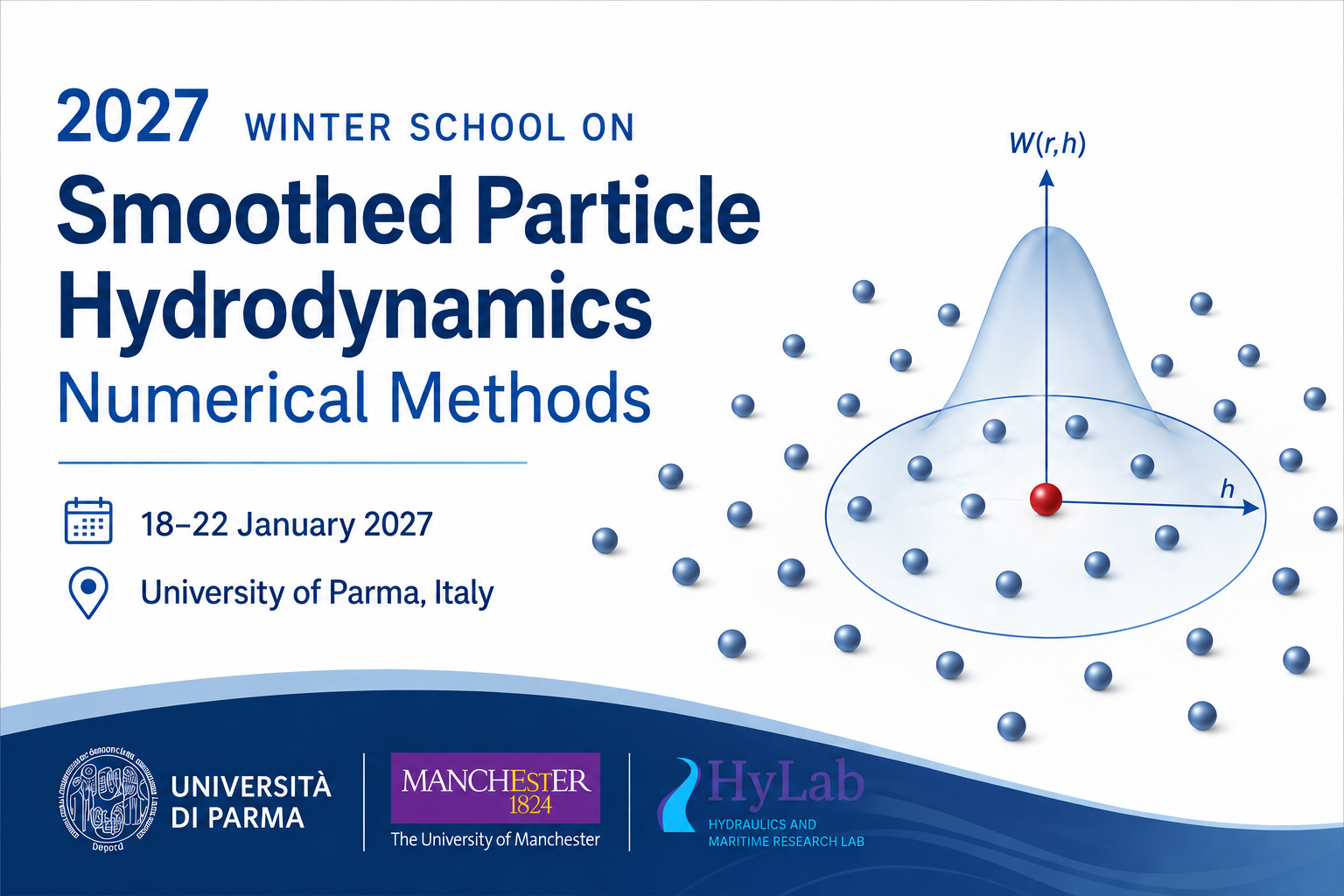
18–22 January 2027 | University of Parma, Italy | In person only
We are pleased to announce the 2027 Winter School on Smoothed Particle Hydrodynamics (SPH) Numerical Methods. The scientific organization of the event is a joint collaboration between the University of Parma and the University of Manchester. The winter school is five-day intensive course covering the theoretical foundations, numerical formulation and practical implementation of SPH methods.
The course combines lectures on fundamental and advanced SPH topics with specialist seminars on selected research areas and a dedicated hands-on DualSPHysics session on the final day.
Main Lecturers
Core teaching team
Renato Vacondio
Benedict D. Rogers
Georgios Fourtakas
Specialist Seminars
Advanced and emerging topics in SPH research
Hands-on DualSPHysics Day
Friday, 22 January 2027
Main Lecturers
The core lectures will be delivered by three researchers with extensive experience in the development and application of Smoothed Particle Hydrodynamics methods.

Prof. Renato Vacondio
University of Parma, Italy
Renato Vacondio is Associate Professor of Hydraulic Structures and Hydrology at the Department of Engineering and Architecture of the University of Parma. His research focuses on hydraulic and hydrological modelling and on the development of meshless numerical methods, with particular emphasis on Smoothed Particle Hydrodynamics (SPH), variable-resolution techniques and high-performance computing. He is President of the SPHERIC Steering Committee and a core developer of the open-source DualSPHysics software.

Prof. Benedict D. Rogers
The University of Manchester, United Kingdom
Benedict D. Rogers is Professor of Computational Hydrodynamics at The University of Manchester. His research focuses on the fundamental development and application of numerical methods for free-surface flows, hydrodynamics and multiphase phenomena, with particular emphasis on SPH and high-performance computing. He is a founding member and former Chair of SPHERIC and a core developer of the open-source SPH codes SPHysics, SWE-SPHysics and DualSPHysics.

Dr. Georgios Fourtakas
The University of Manchester, United Kingdom
Georgios Fourtakas is Senior Lecturer in Mechanical and Aerospace Engineering at The University of Manchester. His research focuses on meshless methods and computational fluid dynamics, including Lagrangian and Eulerian-Lagrangian SPH formulations, multiphase and non-Newtonian flows, sediment transport, boundary conditions and high-performance computing. He is a developer of DualSPHysics with particular expertise in complex flows and advanced SPH formulations.
Who Should Attend?
The Winter School is intended for participants with a solid scientific and technical background who are interested in numerical simulation, computational fluid dynamics and particle-based numerical methods.
The course is particularly suitable for:
- MSc graduates in Engineering, Physics, Mathematics, Computer Science or related disciplines;
- PhD students;
- postdoctoral and academic researchers;
- researchers and engineers working in industry;
- SPH practitioners wishing to strengthen their theoretical background or become familiar with recent developments in the method.
No previous knowledge of SPH is required. The course starts from the fundamental principles of the method and progressively introduces more advanced formulations and applications.
Course Objectives
Participants will:
- understand the fundamental concepts underlying Smoothed Particle Hydrodynamics;
- learn the mathematical basis of SPH interpolation and its consistency properties;
- understand SPH discretisations of the governing equations for fluid flows;
- become familiar with advanced SPH formulations;
- learn about recent developments and current research directions in SPH;
- gain practical experience in setting up and running SPH simulations.
Certificate and ECTS Credits
Participants who attend the course will be eligible to receive a Certificate of Attendance.
The Winter School corresponds to 5 ECTS credits.
Participants will also have the opportunity to take a final examination associated with the course.
Course Topics
The programme consists of approximately 30 hours of lectures, specialist seminars and practical activities.
Topics will include:
- introduction to meshless methods and fundamentals of SPH interpolation;
- consistency and accuracy of SPH approximations;
- SPH discretisation of the continuity and Euler equations;
- compressible, weakly compressible and incompressible SPH formulations;
- advanced SPH schemes;
- fluid–structure interaction;
- multiphase and non-Newtonian flows;
- boundary conditions and numerical implementation;
- high-performance computing and modern SPH implementations;
- recent developments and emerging research topics in SPH;
- practical tutorials and numerical examples.
A detailed daily programme will be published before the course.
Specialist Seminars
A distinctive component of the 2027 Winter School will be a series of specialist seminars on selected topics within the broader field of Smoothed Particle Hydrodynamics.
The seminars will complement the core lectures and expose participants to advanced methodologies, recent research developments and emerging applications of SPH.
The seminar topics and invited speakers will be announced before the course.
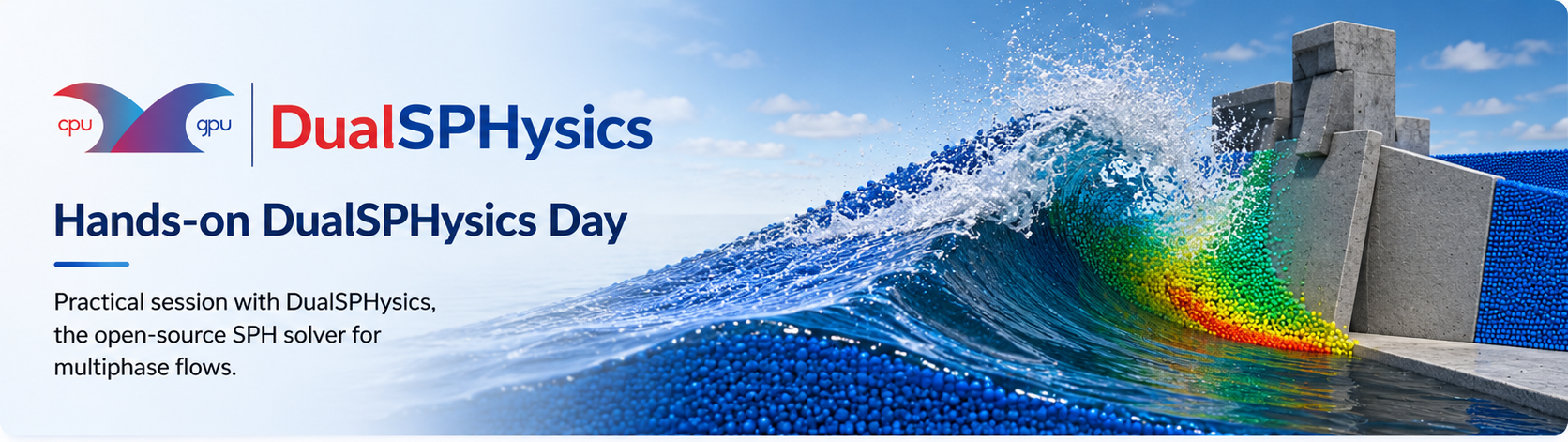
Hands-on DualSPHysics Day
Friday, 22 January 2027
The final day of the Winter School will be dedicated to hands-on numerical activities using DualSPHysics, the open-source SPH software developed by an international collaboration of research institutions.
Participants will work directly with the software through guided practical exercises and will learn how to set up, run and analyse SPH simulations.
The hands-on session will provide an opportunity to apply the concepts introduced during the theoretical lectures and to gain direct experience with a widely used SPH framework for research and engineering applications.
Participants will be encouraged to bring their own laptop.
About the SPH Method
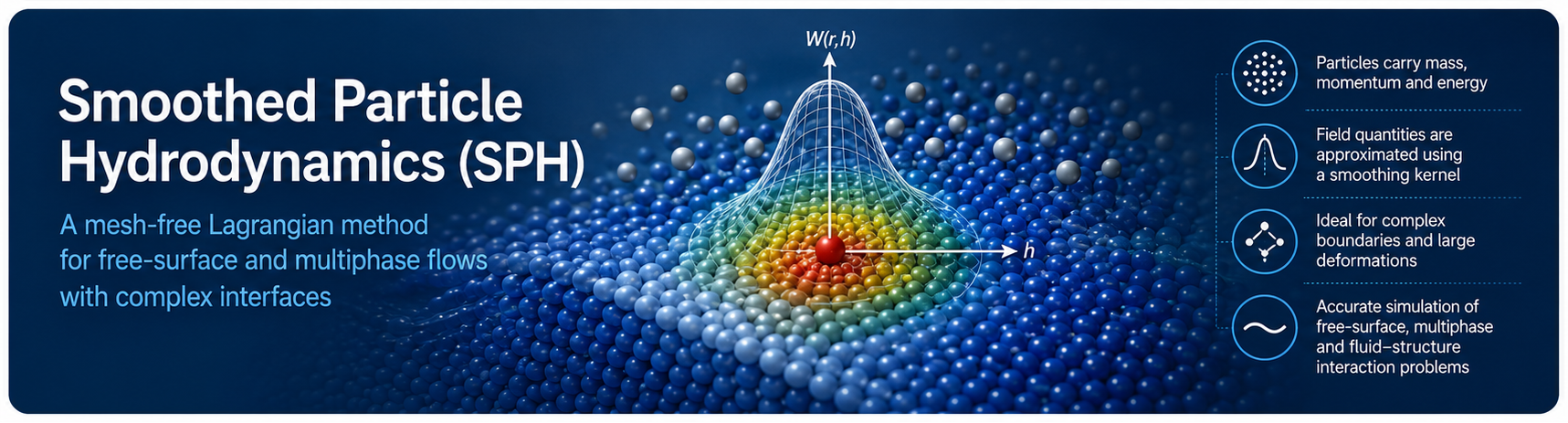
Smoothed Particle Hydrodynamics is a meshless, Lagrangian numerical method originally developed for astrophysical applications and now widely used for the simulation of complex fluid and solid mechanics problems.
Its meshless nature makes SPH particularly attractive for problems involving large deformations, moving interfaces, free surfaces, fragmentation and complex interactions between fluids and structures.
Over the last decades, SPH has become increasingly important in both academia and industry, with applications ranging from hydraulic and coastal engineering to multiphase flows, geomechanics, manufacturing processes, energy systems and many other fields.
Dates and Venue
18–22 January 2027
Department of Engineering and Architecture
University of Parma
Parco Area delle Scienze
43124 Parma
Italy
The Winter School will be held in person only.
Further information on the exact teaching rooms and practical arrangements will be provided to registered participants.
Registration
PhD Students
€500
Other Participants
€800
The course is free of charge for PhD students enrolled at the University of Parma.
University of Parma PhD students who wish to register should contact renato.vacondio@unipr.it directly.
The number of participants is limited to 50.
To register, please complete the online registration form:
Register for the 2027 Winter School on SPH Numerical Methods
How to Reach HyLab
Travel information for reaching HyLab and the Scientific Engineering Campus at the University of Parma is available on our dedicated page.
Accommodation in Parma
Participants may choose from several accommodation options in Parma city centre, with convenient connections to the University Campus by local bus or taxi.
The following accommodation options are provided for information only. Participants are responsible for checking availability, rates and booking conditions directly with each property.
For travel information between the city centre and the University Campus, please see the How to Reach HyLab and the University of Parma Campus page.
Scientific Coordinator
Prof. Renato Vacondio
Department of Engineering and Architecture
University of Parma